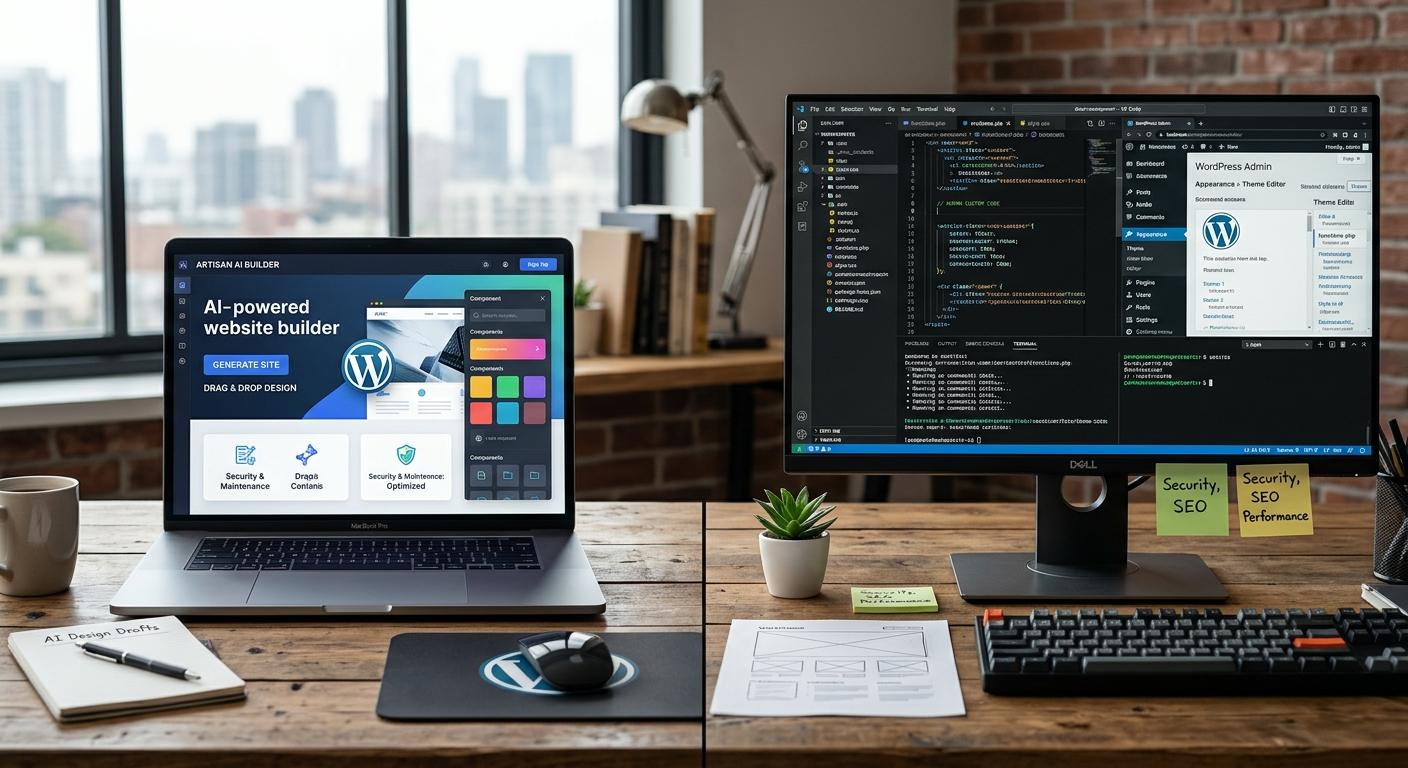
AI website builders are everywhere now. Type a prompt, wait thirty seconds, and you’ve got a homepage, some stock copy, and a colour scheme nobody asked for. It’s genuinely impressive as a party trick. The question worth asking isn’t “can AI build a website?” It clearly can. The question is whether it can build the right website for your business … aaaaaaaannnnnd that’s a different problem entirely.
I’m Andrew, a freelance web developer in London. I spend my days building and maintaining WordPress sites for small businesses, charities, and B2B teams. I use AI tools myself regularly; they save me time on certain tasks, and I’d be daft to ignore them. So this isn’t an anti-AI rant post. It’s a plain look at where AI genuinely helps, and where it quietly creates problems that show up months later, usually right when you can least afford them.
What AI website builders are actually good at
To be fair, AI tools solve a real problem. If you need a single landing page up by tomorrow, or a rough draft to react to, AI can get you there fast. Used alongside a proper development workflow, it can also be a useful companion, speeding up repetitive tasks, generating boilerplate code, or helping you think through a problem faster. It’s genuinely useful for:
- Generating placeholder layouts to kickstart a conversation
- Drafting first-pass copy you can edit
- Producing simple one-page sites for events or short campaigns
- Speeding up small, well-defined tasks within a larger build
- Accelerating parts of the development process when used by someone who knows what they’re doing
None of that is nothing. Speed has value, and time is indeed money. But speed and quality are two very different things, and a website is one of the few places where both matter at once. AI can help a developer work faster, but it can’t replace the developer doing the work.
Why AI struggles with complex or custom projects
Here’s where things get shaky. Most AI website builders work from templates. They’re pattern-matching machines, trained on millions of existing sites, which means they tend to produce something that looks like every other AI-built site. Fine for a hobby project. Less fine when you’re trying to stand out.
Complex builds involve decisions that templates can’t make for you:
- Custom integrations. Connecting a booking system, a payment processor, or a CRM to your site usually means writing or adjusting code to match how your specific tools talk to each other. AI can suggest a starting point, but it doesn’t know your CRM’s quirks, your payment provider’s edge cases, or why your last developer configured something a certain way.
- Accessibility. And this is a big one! An accessible website means people using screen readers, keyboard navigation, or assistive technology can actually use it. AI-generated sites routinely miss this, not because the AI doesn’t know accessibility exists, but because building it properly means checking real behaviour with real tools, not just generating markup that looks correct.
- Performance under real conditions. A site that works fine in a demo can slow to a crawl once it’s handling real traffic, real images, and real plugins. Diagnosing that takes someone who understands servers, caching, and code, not just prompts.
- Business logic. If your site needs to calculate shipping costs for three countries, show different pricing to logged-in members, or route enquiries to different teams, that’s custom logic. AI can write a first draft of the code, sure, but it can’t tell you whether that logic matches how your business actually operates.
- This is the pattern: AI is good at producing something. A web developer is good at producing the right thing, built around how your business actually works.
What happens when AI-built sites go wrong
I’ve been called in to fix countless sites that started with an AI builder and hit a wall. The pattern is usually the same. Someone builds something quickly; it looks fine at first, and then:
- A plugin conflict breaks the checkout page
- The site can’t be updated without breaking the layout
- Security patches never get applied, because nobody’s actually watching
- A feature the business needs- a booking calendar, a members’ area, a multi-language option — simply isn’t something the AI tool supports
- Node dependencies fall out of date, and nothing flags it until something breaks
- JavaScript libraries conflict with each other, producing errors that are tricky to trace without understanding what was installed or why
At that point, fixing an AI-generated site often takes longer than building the equivalent project properly from the start. The underlying code wasn’t written with your specific needs in mind, so a developer has to first work out what’s there before they can fix it. That’s not a knock on AI. It’s just what happens when a tool trained to produce generic output meets a business that isn’t generic.
Security is a good example of where this bites. This month, two critical PHP core vulnerabilities — CVE-2026-109618 and CVE-2026-109619 — were patched in an emergency release. Sites with nobody properly watching them are still exposed. An AI tool won’t tell you that. It won’t notice. That’s the kind of thing that needs a person paying attention.
Who AI tools are genuinely right for (and who they’re not)
Choose an AI builder if your project is short-term, simple, and low-stakes — a single event page, a quick personal portfolio, something you’re happy to replace later. Choose a web developer if your site needs to integrate with other systems, handle real transactions, scale as your business grows, or represent your brand properly for years rather than weeks.
The honest answer isn’t “never use AI.” It’s “know what you’re asking it to do — and know its limits.” A prompt can generate a page. It can’t take ownership of a project, troubleshoot a live issue at 11 pm, or explain in plain English why your hosting setup needs changing. That’s still a job for a person. AI can make that person faster. It can’t replace them.
AI as a companion, not a replacement
The developers getting the most out of AI right now aren’t the ones avoiding it; they’re the ones using it for what it’s actually good at: speeding up repetitive tasks, generating first drafts, testing ideas quickly. Think of it as a very fast assistant that needs supervision, not a developer you can hand a brief to and walk away from.
The judgement, the troubleshooting, and the accountability still sit with a person. AI is a useful tool in that person’s kit. It’s not the kit itself.
If you’re weighing up AI versus a developer for your next website, the real question is simple: how complex is this project, and how much does it matter if something goes wrong? For a quick experiment, AI is fine. For a website your business depends on, you want someone who understands it properly, from start to finish.
Not sure which camp your project falls into? Let’s work it out together.